Singapore Math Primary 3
Model Drawing for Division Word Problems
Division word problems can feel tricky because there’s no obvious “divide” instruction in the sentence. You have to recognize that a total needs to be split into equal parts. A bar model makes this visible: you draw one bar for the total, split it into equal sections, and the answer becomes something you can see rather than guess at.
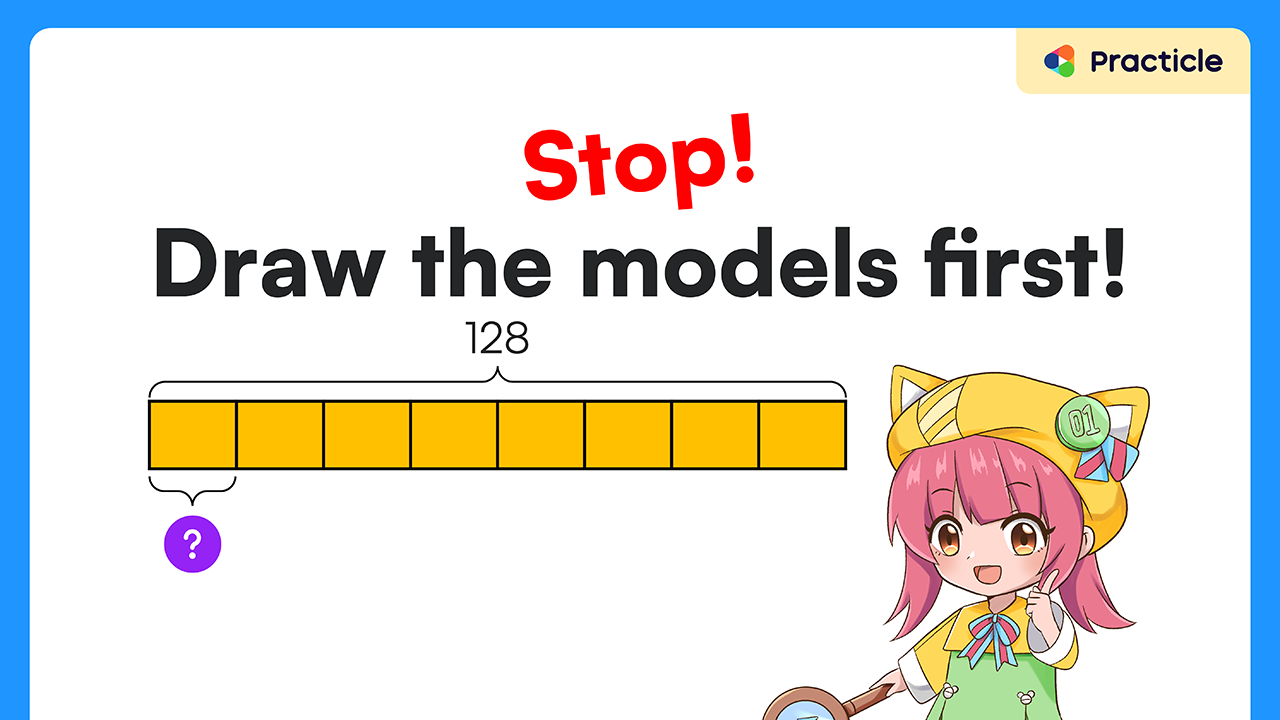
Worked example question:
Puff Puff needs to put 128 hamburgers onto 8 plates for a hamburger eating competition. If the number of hamburgers on each plate has to be the same, how many hamburgers should he put on each plate?
Step 1: Draw a bar for the total..
Draw one bar representing everything we’re dividing up. Label it 128, the total number of hamburgers.
Step 2: Divide the bar into equal parts.
Since the hamburgers need to be split equally across 8 plates, we divide the bar into 8 equal sections.
Step 3: Use the “divide from the middle” trick.
Slicing a bar into equal parts one at a time, left to right, often ends up uneven — a common mistake when kids are new to bar models. The reliable way is to always divide from the middle first: split the bar into 2 equal halves, then split each half into 2 again. For 8 equal parts, that’s two rounds of halving, giving you 8 neat, genuinely equal sections.
Step 4: Mark what you’re solving for.
The question asks how many hamburgers go on one plate, so mark one section of the bar with a question mark — that’s the unknown we’re solving for.
Step 5: Choose the right operation.
We know 8 equal parts together make 128. To find the value of just 1 part, we divide: 128 ÷ 8.
Step 6: Solve in one step.
128 ÷ 8 = 16. Puff Puff should put 16 hamburgers on each plate.
Teacher tip: The “divide from the middle” trick works for any number of equal parts that’s a multiple of 2 (2, 4, 8, 16…). For odd numbers of parts, like 5 or 7, your child will need to estimate and adjust by eye instead — a good next-level bar model skill once this one feels easy.
Why this method works
The “divide from the middle” approach isn’t just a drawing shortcut. It reinforces that each part must be genuinely equal before any numbers are attached, which is the whole point of the model. Kids who slice unevenly from one side often end up miscounting or misjudging which section to solve for. Starting from the middle removes that risk entirely.
Frequently asked questions
What grade are division bar models taught in Singapore?
Division word problems using bar models typically appear from Primary 3 onward, building on the multiplication and sharing concepts introduced in Primary 2.
How is this different from a bar model for addition or comparison problems?
Addition and comparison bar models usually involve two or more bars representing different people or quantities. Division word problems usually involve just one bar split into equal parts, since the goal is to find the value of a single part.
What’s a common mistake kids make with division bar models?
Slicing the bar unevenly by drawing parts one at a time from one side, rather than dividing from the middle outward, is the most common issue — it leads to parts that look equal but aren’t, which can cause errors later.
How can I help my child practice bar models at home?
Use everyday objects (like sharing snacks equally among family members) to build the “equal parts” intuition before introducing the drawing step, then practice the middle-first slicing method with simple numbers like 4 or 8 equal parts.
Related topics
Want more word problems like this one?
Try Practicle free for 7 days! Our gamified adaptive Singapore Math app gives your child bar-model word problems at just the right difficulty level.
Experience Practicle free, no commitment no hidden cost no lock-in
Try our learning platform free with a 7 day trial and see if your child likes it.