Singapore Math Primary 3
How to Find Equivalent Fractions
In this Practicle Equivalent fractions guide, let’s explore what you need to know when learning about fractions in Primary 3!
What are equivalent fractions?
Equivalent fractions are fractions that look different but represent the same value, for example, 2/3 and 4/6. To find an equivalent fraction, you multiply (or divide) both the numerator and denominator by the same number. In Singapore’s Primary 3 math syllabus, this skill is the foundation for comparing, simplifying, and adding fractions in later grades.
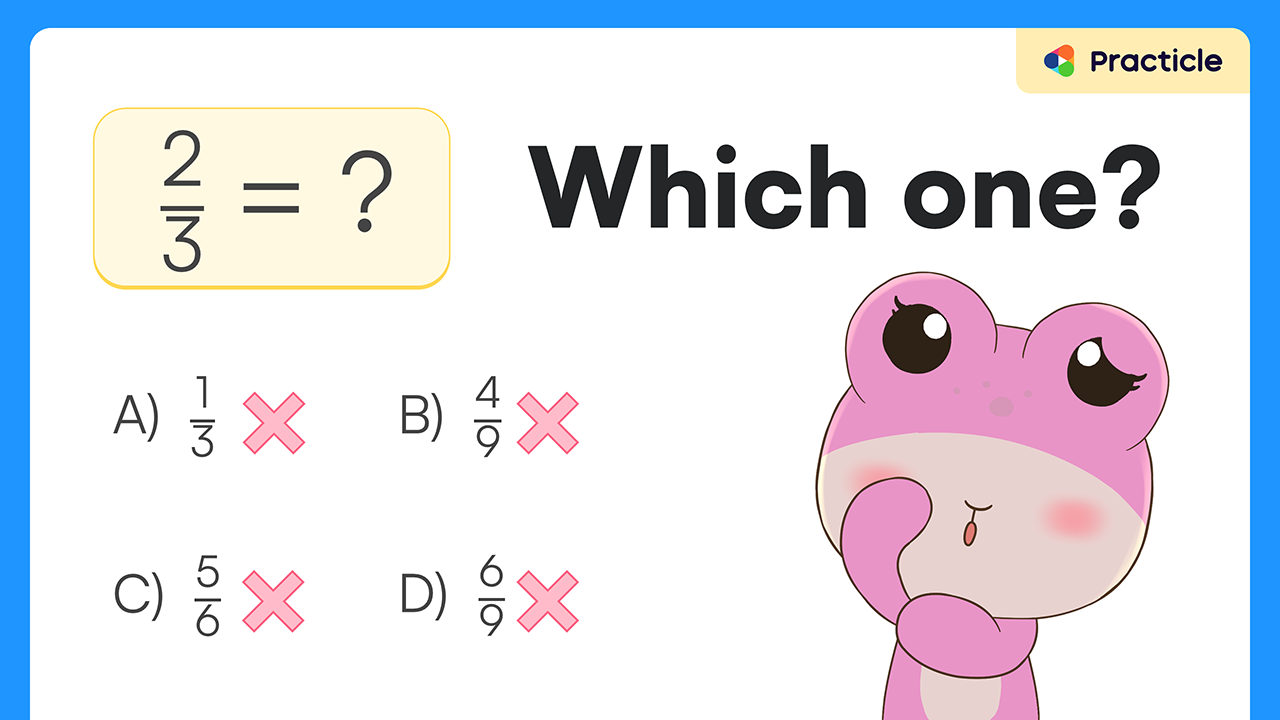
Worked example question:
Which fraction is equivalent to 2/3?
A] 1/3 B] 4/9 C] 5/6 D] 4/6
Step 1: Check if the denominators already match.
Option A, 1/3, already shares the same denominator (3) as 2/3. That means we’re comparing pieces of the same size, so we can tell immediately: 1/3 is not equal to 2/3. Option A is ruled out.
Step 2: For different denominators, multiply to match them.
Option B is 4/9. Since 9 is different from 3, we first need to make the denominators match before comparing. Ask: what do we multiply 3 by to get 9? 3 × 3 = 9. Whatever we do to the denominator, we must do to the numerator too: 2 × 3 = 6. So 2/3 is the same as 6/9, not 4/9. Option B is ruled out.
Step 3: Repeat for the remaining options.
Option C is 5/6. What do we multiply 3 by to get 6? 3 × 2 = 6. Apply the same to the numerator: 2 × 2 = 4. So 2/3 is the same as 4/6, not 5/6. Option C is ruled out.
Step 4: Confirm the answer.
Option D is 4/6, exactly what we calculated in Step 3. 2/3 = 4/6, so the answer is D.
Teacher tip: Even once you spot a likely answer, it’s good practice to check every option before locking it in — it builds the habit of verifying rather than guessing, which matters a lot for PSLE-style questions.
Another way to find equivalent fractions: dividing
Multiplying isn’t the only method. You can also find an equivalent fraction (usually a simpler one) by dividing the numerator and denominator by the same number.
Example: Simplify 6/9 to an equivalent fraction.
Both 6 and 9 can be divided by 3: 6 ÷ 3 = 2, and 9 ÷ 3 = 3. So 6/9 is equivalent to 2/3. This is called simplifying a fraction, and it’s the reverse of what we did above.
Frequently asked questions
What grade are equivalent fractions taught in Singapore?
Equivalent fractions are introduced in Primary 3 under the MOE syllabus, building on fraction basics from Primary 2, and are used again in Primary 4 for comparing and ordering fractions.
Why do equivalent fractions matter for later topics and PSLE?
Equivalent fractions are the building block for adding and subtracting fractions with different denominators, simplifying answers, and solving fraction word problems, all of which appear regularly in PSLE math.
What’s a common mistake kids make with equivalent fractions?
A common error is multiplying or dividing only the numerator or only the denominator, instead of applying the same operation to both. Another is assuming two fractions are equal just because the numbers “look similar” without actually checking.
How can I help my child practice this at home?
Start with the multiplication method using small numbers (×2, ×3), use a bar model or paper strip to show the “same size, different pieces” idea visually, and let them check their own answers by simplifying back down.
Related topics
Ready to try out more fraction practice questions like this?
Try Practicle free for 7 days! Our gamified adaptive Singapore Math app gives your child equivalent fraction questions at just the right difficulty level.
Experience Practicle free, no commitment no hidden cost no lock-in
Try our learning platform free with a 7 day trial and see if your child likes it.