Singapore Math Primary 3
Bar Models: Grade 3 Word Problems
A bar model is a rectangle (or set of rectangles) used to represent the numbers in a word problem visually, making it easier to see relationships between quantities before doing any calculation. In Singapore Math, bar modeling is one of the core heuristics taught from Primary 2 onward, and it’s especially useful for comparison and “how many more/less” word problems like the one below.
Worked example question:
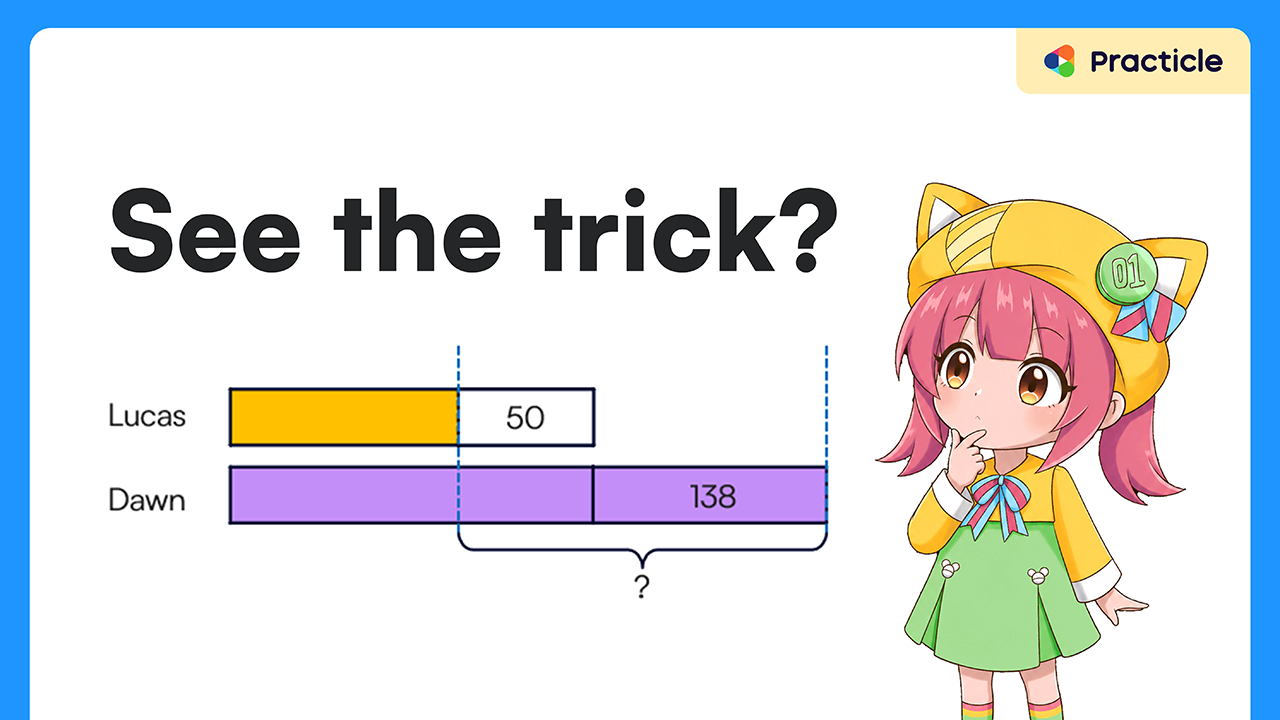
Lucas and Dawn had the same number of Pokemon cards at first. Then, Lucas lost 50 cards and Dawn bought another 138 cards. How many more cards did Dawn have than Lucas in the end?
At first glance this problem involves two people, two changes, and an unknown starting amount — easy to get lost in. A bar model turns it into something you can simply look at and compare.
Step 1: Draw equal starting bars.
Since Lucas and Dawn started with the same number of cards, draw two bars of equal length, one for Lucas, one for Dawn. We don’t know the exact number yet, and we don’t need to.
Step 2: Show what Lucas lost.
Lucas lost 50 cards. Mark off a small section at the end of Lucas’ bar to represent those 50 cards. What’s left of his bar is how many cards he has now.
Step 3: Show what Dawn gained.
Dawn bought 138 more cards. Since 138 is bigger than 50, extend Dawn’s bar outward with a longer section representing those 138 cards. Her whole bar (original amount plus the extension) is her new total.
Step 4: Compare the bars to answer the question.
The question asks how many more cards Dawn has than Lucas. Looking at the model, the “extra” part of Dawn’s bar beyond Lucas’ remaining bar is the difference we’re looking for.
Step 5: Find the hidden equal part.
Here’s the key insight: the part of Lucas’ bar that was removed (50 cards) is the same length as part of Dawn’s “extra” section, because both bars started equal. That means the difference between Dawn and Lucas is simply the 50 cards Lucas lost, plus the 138 cards Dawn gained.
Step 6: Solve in one step.
50 + 138 = 188. Dawn has 188 more cards than Lucas.
Teacher tip: Notice that we never needed to know the starting number of cards at all. This is what makes bar models so powerful for PSLE-style questions — they reveal which numbers actually matter, so you solve problems that look complex in a single calculation.
Why bar models work
Bar models aren’t a trick for one question type, they train a general skill: turning words into a picture before reaching for a calculation. This is exactly what Singapore’s Primary Math syllabus is built around (the “C” and “P” in the Concrete-Pictorial-Abstract approach), and it’s why children who are comfortable with bar models tend to handle multi-step word problems far more confidently by Primary 4 and 5.
Frequently asked questions
What grade are bar models taught in Singapore?
Bar models are introduced in Primary 2 for simple addition and subtraction problems, and become essential by Primary 3–4 for comparison, multi-step, and “difference” word problems like the one above.
When should my child use a bar model instead of just writing a number sentence?
Whenever a word problem involves comparing two quantities, an unknown starting amount, or multiple steps, a bar model helps avoid mistakes that come from trying to track everything mentally.
What’s a common mistake kids make with bar models?
A common error is drawing the bars without first checking which quantities are equal or related — like missing that Lucas and Dawn started with the same amount, which is the key insight that makes this question solvable in one step.
How can I help my child practice bar models at home?
Start with simple two-bar comparisons using small numbers, encourage your child to label each segment before calculating anything, and ask them to explain out loud what each part of the bar represents.
Related topics
Want more word problems like this one?
Try Practicle free for 7 days! Our gamified adaptive Singapore Math app gives your child bar-model word problems at just the right difficulty level.
Experience Practicle free, no commitment no hidden cost no lock-in
Try our learning platform free with a 7 day trial and see if your child likes it.